
Season 6 · Episode 89
The Lights That Did Not Answer: United Flight 105
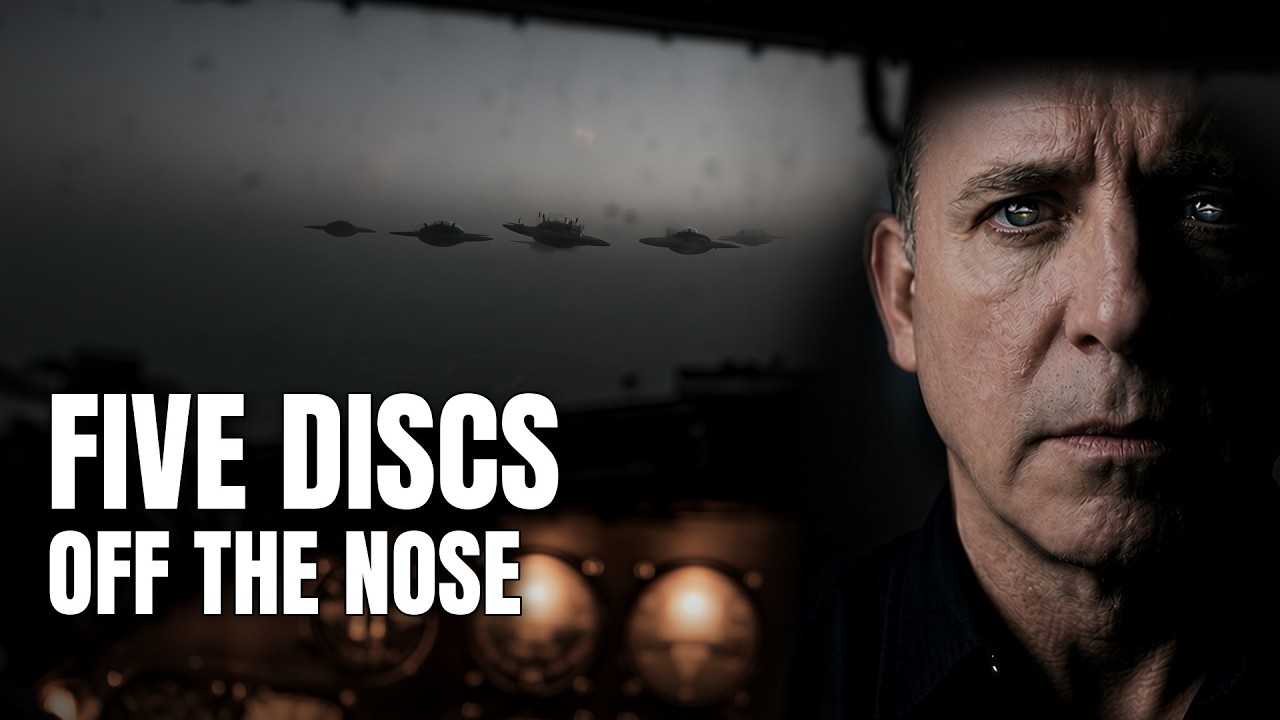
On the night of July 4, 1947, United Air Lines Flight 105, a DC-3 out of Boise bound for Pendleton, Oregon, met five flat, unlighted objects near Emmett, Idaho. Captain Emil J. Smith, First Officer Ralph Stevens and stewardess Marty Morrow watched them pace the airliner, then saw four more. Project Blue Book filed the sighting as case 34, unidentified.
▶ Watch on YouTube♫ Listen on SpotifyApple PodcastsRSS
Key facts
- When
- The night of July 4, 1947; Flight 105 left Boise at 9:04 p.m.
- Where
- From the country over Emmett, Idaho, to a point southeast of Ontario, Oregon, about 45 miles
- Aircraft
- United Air Lines Flight 105, a DC-3, Boise to Pendleton, Oregon, on the way to Seattle
- Witnesses
- Captain Emil J. Smith, First Officer Ralph Stevens and stewardess Marty Morrow; none of the eight passengers saw them
- What they saw
- Five thin, flat discs with no lights, larger than the DC-3; then four more, higher, three in formation and one alone
- How long
- About ten to twelve minutes
- Official file
- Project Blue Book case 34; Hynek found no astronomical explanation
Eight minutes out of Boise
Flight 105 lifted off from Boise at 9:04 p.m. and turned northwest for Seattle, with eight passengers, one stewardess and two pilots. Ten days earlier, Kenneth Arnold's sighting near Mount Rainier had put the words “flying saucer” on the wire, and on the ramp Captain Smith said he would believe in the discs when he saw them.
Climbing through seven thousand feet with Emmett, Idaho, nearly below, First Officer Stevens saw something ahead and blinked the landing lights, the signal pilots used to say they had been seen. Nothing blinked back. The objects were not lighted, and they were not planes: five thin, flat discs, smooth on the bottom and rough-looking on top, climbing with the DC-3 as though in formation.
This episode of My Dark Path follows the crew from the cockpit to the newspapers, Project Blue Book and, years later, physicist James E. McDonald, and asks what the lights that did not answer could have been.
Chapters
- 00:00The Landing Lights That Got No Answer
- 01:48July 4, 1947: United Flight 105 Leaves Boise
- 02:38Kenneth Arnold and the Week of the Flying Saucers
- 03:38Over Emmett, Idaho: Blinking the Landing Lights
- 04:54Five Flat Discs Pace the DC-3
- 06:19The Stewardess: “Yes, What Are Those?”
- 07:28Radio Call to Ontario, Oregon: No One Else Sees Them
- 08:37Four More Discs Vanish Into the Dark
- 09:40Pendleton, Portland and “Frankly, I’m Baffled”
- 11:05Project Blue Book Case 34: Hynek vs. Air Materiel Command
- 12:15James E. McDonald Finds Captain Smith
- 13:01Skeptics at Takeoff, Uncertain at Landing
Questions about United Flight 105
What did the crew of United Flight 105 see?
On July 4, 1947, near Emmett, Idaho, the crew saw five objects flying to the left of their DC-3. They were flat, thin and larger than the airliner, smooth on the bottom and rough-looking on top, with no lights. Later, four more appeared at a higher altitude, three in formation and one alone.
Why didn't the objects answer the landing lights?
First Officer Ralph Stevens blinked the landing lights, the usual signal to another aircraft, and waited for a blink back. He blinked them again. None came. The objects were not lighted, and on a second look they were not aircraft at all. He had first thought they were light planes coming home from a Fourth of July celebration.
Who else saw the discs?
Captain Emil J. Smith called stewardess Marty Morrow to the cockpit to make sure they were not seeing things. She saw the objects immediately, pointed, and asked, “Yes, what are those?” The Civil Aeronautics Administration station in Ontario, Oregon, and the captain of another United flight saw nothing, and none of the eight passengers saw them.
How long did the sighting last?
The crew watched the first five objects for about ten to twelve minutes over roughly forty-five miles. As the last light faded, four more appeared. When Captain Smith tried to close on them, climbing from 7,000 toward 8,000 feet, the discs flew quickly out of sight and disappeared into the dark.
What did Project Blue Book conclude about Flight 105?
The Air Force listed it as Blue Book case 34, near Emmett, Idaho, and kept the objects unidentified. J. Allen Hynek wrote that no astronomical explanation appeared possible. Air Materiel Command later suggested ordinary aircraft, balloons, birds or an illusion caused by the time of day and the objects' position.
Did Captain Smith ever change his story?
No. The next day he wrote an account for the wire services saying he had not believed in flying discs but now did not know what to believe. Years later, physicist James E. McDonald found him in United's New York office. Smith confirmed the published accounts and said there had been no cloud to confuse them.
Sources
Documents described in this episode:
- Dave Johnson, “Sight Nine Objects in Two Groups; Portlanders, Boiseans Eye ‘Saucers,’” Idaho Statesman (Boise), July 5, 1947, pp. 1–2
- “Air Liner Crew Confirms Flying Discs Over State,” The Oregonian (Portland), July 5, 1947
- Capt. E. J. Smith, “Frankly, I’m Baffled,” written for International News Service, The Oregonian, July 6, 1947 (dateline Seattle, July 5)
- Associated Press and United Press dispatches, July 5, 1947
- Project Blue Book, Case 34 (filed as Incident 10), near Emmett, Idaho, July 4, 1947
- Astronomical evaluation sheet on the Blue Book file (J. Allen Hynek): “There appears to be no astronomical explanation for this incident.”
- Air Materiel Command / Project Grudge summary, August 1949
- James E. McDonald, prepared statement, Symposium on Unidentified Flying Objects, House Committee on Science and Astronautics, July 29, 1968, pp. 41–42 (Case 1)
- Project 1947, “UAL Flight 105, July 4, 1947” (drawing on Loren E. Gross, UFOs: A History, 1947)
- NICAP AVCAT directory (Fran Ridge summary and Brad Sparks, Blue Book Unknowns no. 34)
- Weight of Evidence case summary
Music
Music licensed from Soundstripe. Listen to the episode playlist.
- Sleep, Stephen Keech
- Brenner, Falls
- The Birth Of A Planet, Falls
- Starseed, Wayfair
More cases from the dark path
Episode script
(full text, tap to expand)
The pilot reached for the switch to the plane’s landing lights.
Eight minutes out of Boise in 1947, the sky ahead of the DC-3 still held the last light of the day. In that growing dark, an object in the sky caught the pilot’s eye.
The object was unexpected. No other aircraft was supposed to be in that part of the sky. So he flipped the switch the way you do when another plane is in the same piece of sky and has not seen you yet.
The lights came on.
The object in front of him did not answer.
The pilot blinked the lights again.
The co-pilot, now aware of the pilot’s action, simply asked: what are you doing?
The pilot said: There's a plane approaching off our nose.
A few seconds later that sentence was already wrong. What flew ahead of them did not only fail to answer their lights. It was not a plane at all. There was no tail or wings. Instead, the object was flat. Smooth on the bottom, with some structure that made the top surface look rougher.
As their DC-3 closed on the object, its features came more into focus. And the pilot spoke again.
There is not one aircraft. There are five. And it was not surprising that their landing lights had gone unanswered.
I'm MF Thomas, and welcome to My Dark Path through the unexplained. This is season 6, episode 89, The Lights That Did Not Answer.
It was the night of July 4, 1947. United Air Lines Flight 105, a DC-3, had lifted off Boise's field at 9:04 and turned northwest for Seattle. The first stop was Pendleton, Oregon. Eight passengers sat in the cabin along with a single flight attendant. Up front were Captain Emil J. Smith and First Officer Ralph Stevens. Stevens was flying that night.
Neither one was new to commercial aviation. Captain Smith had been with United for fourteen years, from about 1933. Newspaper reports later identified both as World War II veterans. First Officer Stevens had been with United for three years, from about 1944.
That week's newspapers were already full of news about mysterious flying objects. Ten days earlier, a Boise pilot named Kenneth Arnold reported nine objects near Mount Rainier. The news had gone global over the wire with a particularly important piece of misinformation – the phrase flying saucer had been used to describe the objects. Arnold later clarified that the objects were not shaped like saucers; instead, they flew like saucers skipping across water.
Later Captain Smith would write that up until that night he had discounted most of the UFO sightings he had read or heard. But the topic was of such interest that even on the ramp at Boise, someone mentioned the day's sightings. Smith reportedly said that he would believe in those discs when he saw them. The tower, bidding the flight farewell, jokingly warned them to look out.
Now mid-flight, Smith and Stevens were not expecting to see anything in the sky. They were climbing through seven thousand feet, heading about three hundred degrees, with Payette country going dark under their wings. The town of Emmett, Idaho, was nearly below them.
That’s when Stevens saw something ahead of them and reached for the landing lights. It was something strange and unexpected. And the procedure he had been taught and followed was simple—flash your landing lights and wait for the other aircraft to flash theirs in recognition, letting you know that you had been seen.
The responding blink did not come.
Flashing the landing lights was a common signaling technique at the time. A pilot who thought another airplane was coming at him head-on blinked them and waited for the blink that meant he had been seen.
The objects were not lighted. Stevens blinked the landing lights a second time and received no acknowledgment. His first thought, he said later, was that the objects were a group of light planes coming home from a Fourth of July celebration. The thought did not survive the second look.
Smith asked why the lights were on. Stevens told him an aircraft appeared off their nose. A moment after that, Stevens called out again. There was not one aircraft. There were five.
They flew to the left of the DC-3. Flat. Circular. And larger than their own airplane. Although the craft did not respond to their signal, after watching them for a few more seconds, they realized they were not on a collision course.
Instead, the five discs were climbing along with the DC-3, pacing their aircraft as though in formation. Smith would tell the United Press, more carefully, that he could not say for sure whether they were completely circular or oval in shape, or anything certain about their size, only that they were thin, smooth on the bottom, and rough-looking on top.
The DC-3 was noisy in its typical way—two loud engines and the sound of the wind rushing by the fuselage. They heard nothing over the sound of their own airplane as they watched the objects.
His hands stayed on the airplane's yoke, following the first rules of flying: aviate, navigate, communicate. But they were both astonished by the sight of the objects.
They were not aircraft.
As if to dispel their disbelief, Smith called the stewardess forward into the cockpit.
A moment earlier, Marty Morrow had been working in the cabin, tending to the eight passengers aboard the flight. The ordinary work of a westbound evening.
Smith said he brought her up so they could prove to themselves they were not seeing things. In the account he wrote the next day, he had asked her a plain question. Do you see anything in the sky around us?
The pilots were not delusional. She saw the objects immediately and pointed. And asked: Yes, what are those?
That was her whole report. It was enough to expand the witnesses of the flying objects beyond the two pilots alone. It was enough to confirm something else was in the sky.
The instrument lights were the only warm color in the cockpit. Ahead of the plane's nose, the sky was still faintly lit, and the five shapes continued to fly ahead of them.
After a few minutes passed, Smith got on the radio to contact the Civil Aeronautics Administration station in Ontario, Oregon. He gave them their flight path and altitude and asked if they could see what he saw. The operator stepped outside and looked in the direction he had been given. He could not see anything.
Another United flight was coming in from the east. Captain Emory Culbertson, commanding Flight 130, would land at Boise at 9:45. He saw nothing. Smith said later that was understandable. Culbertson was flying east into a darkening sky. Flight 105 was flying west toward the last of the light.
They watched the five UFOs for about ten or twelve minutes over a distance of about forty-five miles, from the country over Emmett to a point southeast of Ontario.
The five unidentified flying objects continued west, pacing the plane as they flew into that falling dark.
Then, as the last of the light faded, the pilots saw four more.
They were at a higher altitude than their DC-3, which by then was flying at about seven thousand feet. Three objects flew together in formation, and a fourth flew off by itself. The same flat shape. The same absence of lights.
Concerned that they would lose them as night fell completely, Smith tried to close on the discs. The reports recorded their speed at nearly 185 miles per hour as they climbed from 7,000 toward 8,000. Perhaps responding to the DC-3’s more aggressive stance, the discs did not wait. They flew quickly out of sight and disappeared into the dark.
None of the eight passengers saw them. Smith wrote that the objects had been off the front and that he and Stevens had not thought to turn the airplane, so they were so focused on keeping the objects in sight.
With the unidentified flying objects gone, they finished their flight to Pendleton.
Smith had radioed ahead. He told the tower he and the crew had just seen a flock of the discs. The tower called the paper. A reporter was on the telephone as the DC-3 taxied into the gate.
From Pendleton, Smith spoke to the Idaho Statesman, with their reporter, Dave Johnson, taking down the story. He summarized their experience – nine objects, in two groups. Not birds. Not aircraft. Not anything from the ground. He could not identify them.
With that interview done, they completed their final leg to Portland. When they arrived, Smith’s next report was more concise. No object he knew of could disappear so quickly. Stevens, talking to reporters in Portland, shared the same story and no better name for what they had seen.
The next day Smith wrote a detailed story for the wire news services. Clarifying that he was not a believer in flying discs previously, but that now he didn’t know what to believe. In all the time flying during the war and in his fourteen years with the airline, he had never seen anything like it.
The story left the airport faster than the airplane had. It ran on the wire beside the rest of that week, a week in which UFOs were featured daily across the country. What set this one apart, for the papers that still sensed the difference, were the witnesses—two men with a high level of credibility as pilots along with a third pair of eyes of the stewardess who also saw the objects.
The Air Force picked up the report.
In the Blue Book list, it is case 34, near Emmett, Idaho, the night of July 4. Maintaining that the objects were unidentified. J. Allen Hynek, reviewing it, wrote that no astronomical explanation appeared possible. Air Materiel Command, looking at the same sunset, later said the objects could have been ordinary aircraft, balloons, birds, or an illusion, since the time of day and their position made illusions most likely, and the week was one when everyone was on the lookout for UFOs in light of Arnold’s experience.
Years later while researching UFO cases, atmospheric physicist James E. McDonald found Smith in United’s New York office and walked him back through the published accounts. Smith confirmed them. He told McDonald there had been no cloud to confuse them, and that they had watched long enough to be certain the objects were not conventional aircraft or balloons. He held firm to all the previous elements of his previous testimony.
McDonald spoke with United people who had known Smith for years. They vouched for his complete reliability. The reliability did not produce a name for what he saw that night.
On July 4, Smith and Stevens had followed their procedures. You see an object off the nose. You blink the landing lights. You wait for the blink that means another airplane has seen you.
The responding blink did not come. They left Boise that night as skeptics. A day later, they were now uncertain. They had seen something extraordinary in the skies with them. They were unable to explain what they had seen.
Thanks for joining me in this episode of My Dark Path through the unexplained. I'm MF Thomas. Until next time, my friends, good night.